Europe bans the destruction of unsold textiles: a major step towards circular textile territories

February 2026
The European Union has taken a decisive step in advancing a circular textile economy in Europe.
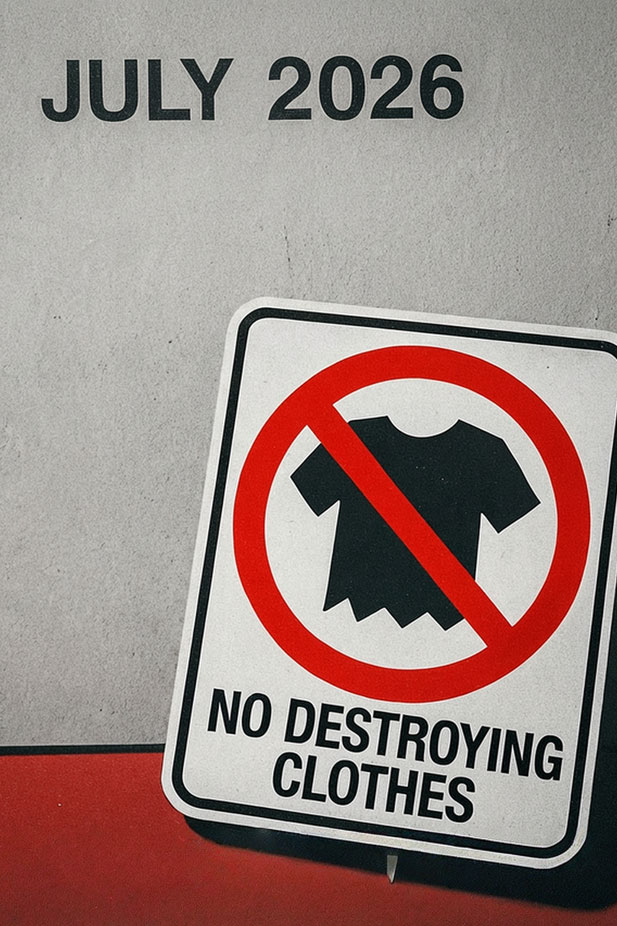
Under the Ecodesign for Sustainable Products Regulation (ESPR), the European Commission has adopted new rules banning the destruction of unsold clothing, footwear and textile products. The measure will apply to large companies from July 2026 and will extend to medium-sized enterprises by 2030.
This landmark decision represents a structural shift in EU textile regulation, reinforcing sustainability, transparency and lifecycle responsibility across the European fashion and textile industry.
A turning point for the European textile industry
The destruction of unsold garments has long been a major environmental and economic concern within the global fashion system. By introducing this ban, the European Union strengthens its leadership under the EU Strategy for Sustainable and Circular Textiles and the broader Green Deal framework.
The new regulation is expected to:
Accelerate the transition to a circular textile economy in Europe
Encourage reuse, repair and recycling models
Increase transparency across textile value chains
Reduce textile waste at its source
Promote more responsible production and inventory management practices
For Europe’s textile and fashion ecosystems, this is not only regulatory evolution — it is systemic transformation.
What does the EU textile ban mean for municipalities and textile regions?
Textile territories across Europe — many of them represented within ACTE — play a crucial role in implementing sustainable textile policies at local level.
Municipalities and regional ecosystems are uniquely positioned to:
Develop local circular textile infrastructure
Strengthen textile waste prevention and management systems
Support SMEs and designers in adapting to EU sustainability requirements
Transform industrial heritage sites into innovation hubs
Foster cooperation between public authorities, clusters and companies
Circularity becomes tangible in territories.
It is implemented locally, through governance, collaboration and innovation.
Institutional perspective from ACTE
According to ACTE’s leadership, this decision reinforces the strategic role of textile municipalities in Europe’s green transition.
“The ban on the destruction of unsold textiles is a strong signal that Europe is serious about circular transformation. Textile territories are not just affected by this change — they are key actors in making it happen,” said a representative of ACTE’s Executive Board.
“Municipalities with textile heritage and industrial capacity have the responsibility and the opportunity to lead sustainable innovation. Through cooperation and European networking, we can turn regulation into territorial opportunity.”
ACTE reaffirms its commitment to supporting member municipalities and textile ecosystems in adapting to this new regulatory landscape.
Through European projects, knowledge exchange and interregional cooperation, ACTE continues to strengthen the competitiveness, resilience and sustainability of Europe’s textile territories.
Towards a circular and territorially-driven textile future
The EU ban on the destruction of unsold clothing is more than a compliance measure. It represents a redefinition of value in the European textile system.
- Value must be preserved.
- Resources must be optimized.
- Territories must be empowered.
As a European network of municipalities linked to textiles, fashion, footwear and accessories, ACTE believes that the future of European textiles is circular, innovative and territorially driven.
The fabrics of the future will not only be sustainable.
They will be woven locally.